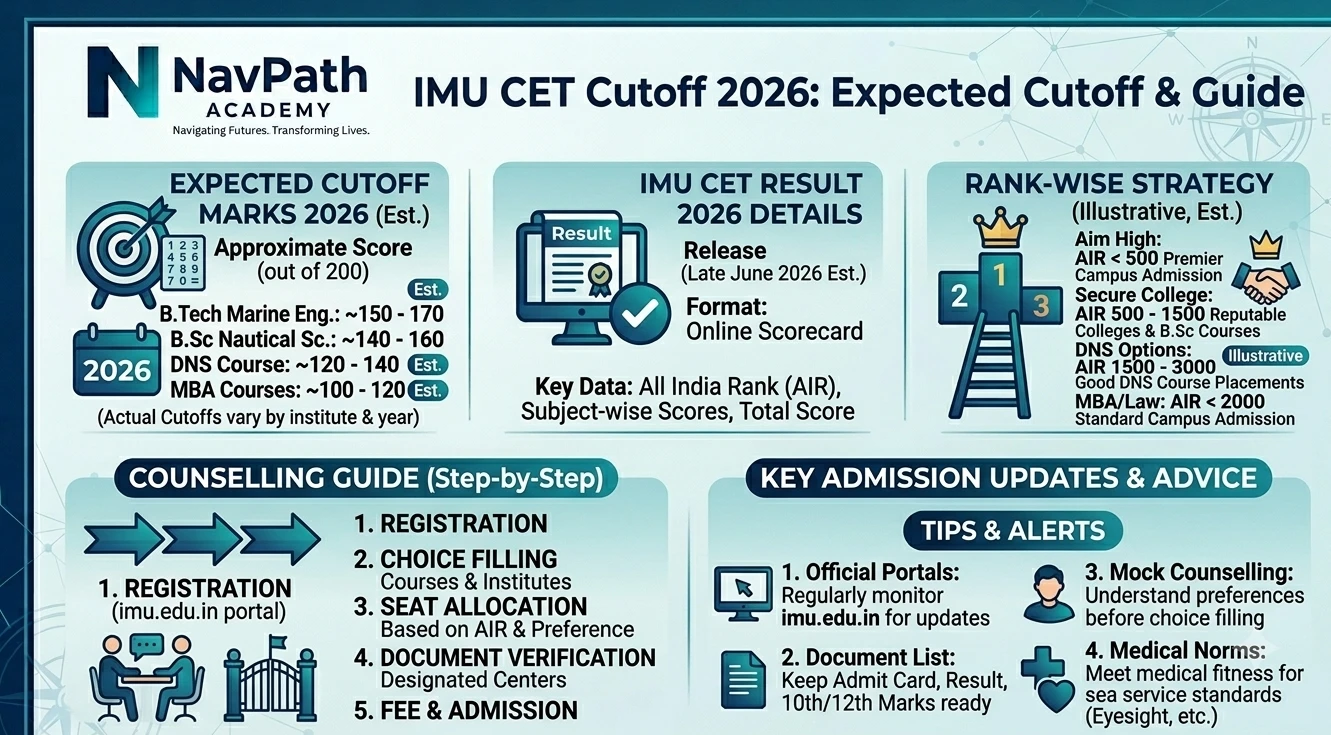
IMU CET Results 2026 is officially out. If you have been searching for the IMU CET Cutoff 2026 — what score qualifies, how your rank stacks up, and what happens next — this is the only guide you need right now. IMU CET declared the result on 14 June 2026, rank cards are live at imu.cbexams.com, and counselling has already commenced. There is no time to sit on this.
This article covers the marks-vs-rank breakdown, category-wise cutoff data, course-wise rank strategy, and a complete counselling checklist — everything from reading your rank card to deciding whether to pursue DNS, BTech Marine Engineering, or BSc Nautical Science.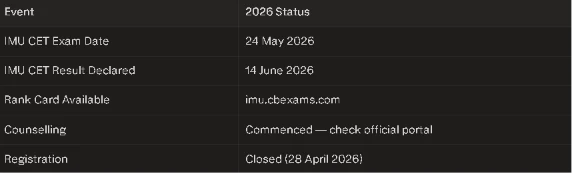
What Is IMU CET Cutoff?
The IMU CET cutoff is the threshold — either a minimum marks score or a closing rank — below which a candidate does not get considered for a specific course or campus. It sounds simple, but students often confuse two very different types of cutoffs.
The qualifying cutoff is the minimum marks you need to score to be considered at all. This is fixed based on category and is tied to the eligibility requirements.
The admission cutoff is the closing rank — the last rank at which a seat was offered in a specific course at a specific campus during a specific counselling round. This number changes every year based on how many students appeared, how difficult the paper was, and how many seats are available.
IMU does not publish a single universal cutoff figure. What actually determines your fate is whether your rank falls within the closing rank for your preferred course-campus combination during counselling. A rank of 1,200 might comfortably secure a seat in Naval Architecture at Visakhapatnam while falling short for BTech Marine Engineering at Chennai. That distinction matters enormously when you are filling your counselling choices.
For the complete picture of IMU CET 2026 — eligibility, exam pattern, admit card, and result — read the IMU CET 2026 complete guide.
IMU CET Results 2026 Details
This is genuinely one of the most confusing points for first-time IMU CET candidates, and most information sources handle it poorly.
Cutoff marks = the minimum raw score you need to achieve a qualifying status. Scoring below this means you do not make it to counselling, regardless of category.
Cutoff rank = the closing rank at which the last seat was allotted in a given course at a given campus during a counselling round. This is what determines admission — not your marks in isolation.
Here is the estimated marks-to-rank distribution for 2026, based on post-exam analysis and 2025 trends: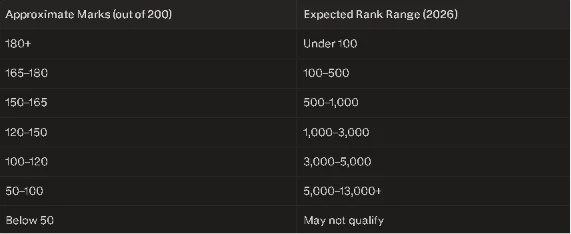
Important disclaimer: The 2026 paper analysis after 24 May confirmed that the Mathematics section was noticeably difficult and the Physics section was lengthy. IMU applied percentile-based normalization for the dual-shift 2026 exam. This means your raw score is not your final score — the normalized score determines your actual rank. A student who scored 130 raw in the morning shift may rank differently from someone who scored 130 in the afternoon shift after normalization is applied. Do not compare raw marks with friends across shifts.
IMU CET Cutoff 2026 — Category-Wise Overview
The category-wise qualifying criteria for IMU CET are tied to both eligibility and admission:
General (UR): Minimum 60% aggregate in Physics, Chemistry, and Mathematics (PCM); minimum 50% in English
SC/ST candidates: 5% relaxation on minimum qualifying marks
Admission closing ranks: Separate lists are published for General and reserved categories during counselling
The table below shows IMU CET 2025 closing ranks from the last counselling round for General category candidates. Use this as your reference benchmark for 2026 planning.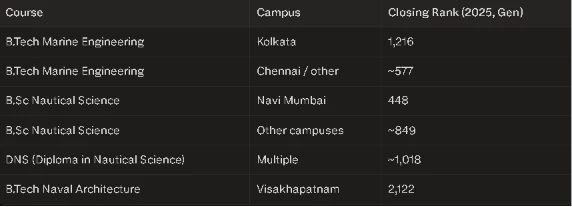
2026 cutoff data will be updated once official counselling rounds close. Bookmark this page.
SC/ST candidates should check the category-wise closing rank lists published separately on the IMU counselling portal — the closing ranks for reserved categories are typically higher numbers (meaning more candidates can qualify), so do not assume your rank is too low before checking both lists.
Factors That Affect IMU CET Cutoff 2026
Seven factors shape how tight or lenient the cutoff turns out each year:
Total number of candidates — A larger applicant pool compresses the qualifying band and makes lower ranks more competitive. IMU CET 2026 saw strong participation nationally.
Paper difficulty — The 2026 paper had difficult Mathematics and a lengthy Physics section. When the paper is harder, fewer students score in the top bands, which typically pulls qualifying cutoffs slightly downward.
Normalization — IMU applied percentile-based normalization for the dual-shift 2026 exam. Raw marks are adjusted before ranks are assigned, so the marks-vs-rank table is indicative, not exact.
Available seats — Each course and campus has a fixed seat count. More seats in a programme means a higher closing rank (more inclusive). Seat additions or reductions directly shift the cutoff.
Course demand — BTech Marine Engineering and DNS remain the two most competitive programmes year after year. Naval Architecture and MBA programmes typically have higher closing ranks.
Category — SC/ST candidates compete within a separate closing rank pool. Checking both lists before ruling out a campus is essential.
Sponsorship status — Candidates with a confirmed maritime company sponsorship enter through a separate track entirely. They do not compete for open general seats. Their path to admission bypasses the standard cutoff competition.
Note: If you are a sponsored candidate or actively pursuing sponsorship, your cutoff pathway is different from an open-category applicant. Navpath Academy guides students through sponsorship preparation as an integrated part of its IMU CET training programme.
IMU CET Result 2026 — What to Check in Your Rank Card
IMU declared the IMU CET result 2026 on 14 June 2026. Rank cards are available for download at imu.cbexams.com right now.
Your rank card contains the following:
Application number
Candidate name
Subject-wise marks (Physics, Chemistry, Mathematics, English, General Aptitude)
Total marks scored
All India Rank (AIR)
Category rank
Qualifying status (Pass/Fail)
Do not just download the PDF and close it. Go through each field deliberately:
Is your name, date of birth, and category correctly reflected? If anything is wrong, flag it to IMU immediately — before counselling begins. A category error could cost you reserved-category benefits.
Is your qualifying status marked "Pass"? If it shows "Fail," check whether you meet the eligibility criteria; some students fail at the English marks threshold despite scoring well in PCM.
Compare your General rank and your Category rank — both matter depending on which seat pool you are applying under.
Check your rank against the 2025 closing rank table above to get a realistic sense of which courses and campuses are within reach.
Think of your rank card as a boarding pass. It tells you which deck you are eligible to step onto — but you still have to navigate the counselling process to actually board.
Rank Strategy for DNS, B.Tech Marine Engineering, and B.Sc Nautical Science
Rank Strategy for DNS (Diploma in Nautical Science)
DNS is the most directly tied to maritime employment of all IMU programmes. It is short, intense, and designed to get you sailing as a deck cadet. For open-category candidates without a sponsor, a rank under 1,200 gives you solid campus options based on 2025 data.
The key variable for DNS is sponsorship. A confirmed sponsorship from a DGS-approved shipping company changes everything — you apply through the sponsored track and do not compete for open seats at all. If you are targeting DNS and your rank is borderline, pursuing a sponsorship should be your immediate parallel priority.
Rank Strategy for B.Tech Marine Engineering
BTech Marine Engineering is the highest-demand programme and has the tightest closing ranks. If you want Chennai or Mumbai campuses, you need a rank under 600 based on 2025 trends. Ranks between 600 and 1,500 still open doors at newer and regional campuses that offer the same degree with strong placement outcomes.
Do not fixate on only one or two campuses. The degree is the same — the campus name matters less than the quality of training and the connections you build onboard after graduation.
Rank Strategy for B.Sc Nautical Science
BSc Nautical Science is often overlooked in favour of BTech but it is actually a faster pathway to a sailing career. The academic duration is shorter, and cadets from this programme join ships earlier. For Navi Mumbai, aim for a rank under 500. Other campuses typically have closing ranks around 849–1,000 based on 2025 data.
If your goal is to sail early and start building sea time, BSc Nautical Science deserves serious consideration — especially if your rank sits between 500 and 1,200.
Your rank is one factor. Your sponsorship readiness, preferred campus, backup course choices, and long-term maritime goal all define your final decision. Map your options clearly before the counselling window closes.
What to Do If Your IMU CET Rank Is Low
First, understand that "low" is relative. A rank of 2,000 sounds discouraging if you were aiming for BTech Marine Engineering at Chennai. The same rank can comfortably open seats in BTech Naval Architecture at Visakhapatnam or MBA in Port and Shipping Management — legitimate maritime career pathways that do not get enough credit.
Here is how to think through this practically:
1. Explore all campuses, not just the famous ones. Newer IMU-affiliated institutes have higher closing ranks. The degree quality and career outcomes are comparable, and in some cases, smaller campuses mean more individual attention and tighter industry connections.
2. Consider adjacent maritime programmes. If your rank does not qualify for DNS or Marine Engineering, programmes like MBA in Port and Shipping Management keep you firmly in the maritime industry with strong career upside. These programmes often have closing ranks well above 2,000.
3. The sponsorship track is a genuine alternative. A confirmed shipping company sponsorship removes you from open-seat competition entirely. Securing a sponsorship requires interview readiness, maritime fitness, and company-specific preparation — none of which depend on your IMU CET rank.
4. Consider the 2027 cycle with structured preparation. Students who attempt IMU CET a second time with proper coaching typically see rank improvements of 2,000–5,000 positions. Starting now — rather than waiting until January — is the difference between a serious attempt and a repeat of the same result.
5. Do not take admission decisions under panic. Read the counselling data, talk to someone who understands the matrix, and make a decision based on your actual options — not assumptions.
Many of the best deck officers and marine engineers in India did not rank in the top 100. What matters is getting in, training well, and landing a sponsorship. Navpath Academy works specifically with students in this situation — helping them identify realistic admission paths and prepare for sponsorship interviews that coaching institutes rarely cover.
How IMU CET Coaching Improves Cutoff Performance

The gap between a rank of 800 and 3,000 often comes down to 15–25 marks. That is not a talent gap — it is an execution gap. Structured coaching addresses exactly this.
Mock tests and accuracy work are the biggest lever. Most students lose marks not because they do not know the concept but because they misread a question, make a calculation error under time pressure, or run out of time in the Mathematics section. Regular timed mocks — with detailed error analysis — eliminate these patterns before the real exam.
Maritime-specific mentors understand the IMU CET paper in ways that generic coaching cannot. They know which Physics chapters have historically dominated the paper, where the time traps in Mathematics appear, and how the English section is structured differently from JEE or NEET formats.
Sponsorship preparation is the layer that separates good maritime coaching from great maritime coaching. Coaching that trains you only on exam content prepares you for one day — exam day. Training that includes shipping company interview preparation, fitness standards, maritime general knowledge, and communication skills prepares you for a career. This is where best IMU CET coaching in India makes a tangible long-term difference.
If you want to understand how to build a study plan from scratch for the 2027 cycle, read the guide on how to prepare for IMU CET.
IMU CET Counselling 2026 — Checklist for Registered Candidates
Counselling has commenced. Work through this checklist before you make any choices on the portal.
Download rank card from imu.cbexams.com and save multiple copies (PDF + printout)
Cross-check rank against 2025 closing ranks for your target courses and campuses
Shortlist 3–5 course + campus combinations in priority order — do not apply to just one
Collect original documents: Class 10 and 12 mark sheets, birth certificate, school leaving certificate, ID proof, passport-size photographs
Verify medical fitness requirements for your chosen programme (DNS and Nautical Science have vision and physical fitness requirements)
If applying under reserved category, confirm your category certificate is current and valid
Keep your counselling registration fee payment method ready (net banking, UPI, or debit card)
Track the official IMU counselling schedule closely — missing a round deadline can result in seat cancellation with no recourse
If you are a sponsored candidate, carry your company sponsorship letter and verify the company is DGS-registered
Contact the official IMU helpline or your coaching advisor for real-time updates on round-wise seat availability
Navpath Academy's team helps IMU CET aspirants map their rank, evaluate course options, and prepare for sponsorship — call us for a guidance session before you lock in your counselling choices.
How to Download IMU CET Rank Card 2026 — Step-by-Step Guide
What you need:
Application Number (from your IMU CET registration)
Registered password
Internet browser (Chrome recommended)
PDF viewer and printer or PDF saver
Estimated time: 5–10 minutes
Steps:
Open Chrome (or any updated browser) and navigate directly to imu.cbexams.com — type the URL manually to avoid third-party redirect sites that may not be official.
On the homepage, look for the notification banner or link titled "IMU Admissions 2026 – Rank Certificate Download Link" and click it. If the homepage has been updated, check the "Latest Updates" or "Notifications" section on the left panel.
You will be redirected to a secure login page. Enter your Application Number (exactly as you used during registration) and your Password. Both are case-sensitive.
Click Login or Submit.
Once you are inside your dashboard, locate and click the "Download Rank Card" or "Select Download Rank Card" button. It may appear as an icon or a text link depending on the portal version.
Your rank card will open as a PDF in a new tab or download directly to your device. It will display your subject-wise marks, total score, All India Rank (AIR), category rank, and qualifying status.
Save the PDF to your phone and email it to yourself as a backup immediately.
Print at least 3–4 copies — document verification during counselling reporting requires original hard copies, not just a phone screenshot.
Troubleshooting:
Forgot password? Use the "Forgot Password" link on the login page. An OTP will be sent to your registered mobile number or email.
Rank card not visible? Confirm the result has been officially declared. If the download option appears greyed out, the result may still be in processing for your application — check again after a few hours.
Name or date of birth error? Contact IMU's official helpline immediately. Do not wait until counselling day to discover a mismatch — it can delay your document verification.
Portal loading slowly? Result portals always experience peak traffic around declaration time. Try accessing at early morning (before 8 AM) or late night for faster load times.
Once you have your rank card, compare your AIR against the 2025 closing rank data in the category-wise section above and map your course-campus choices before the counselling window moves to the next round.
Your rank card is in hand. Now comes the part that actually decides which ship you sail on — counselling, course selection, and sponsorship preparation.
At Navpath Academy, our team of captain-mentors helps IMU CET aspirants read their rank correctly, choose courses that align with their maritime goals, and prepare for sponsorship interviews that most coaching institutes never cover. Whether you ranked in the top 200 or need a clear-eyed plan for your next attempt — start with one call. We will tell you exactly where you stand.
Need guidance from NavPath Academy?
Need Counselling
Related Articles