B.Tech Marine Engineering · Engine officer route · IMU CET preparation

B.Tech Marine Engineering After IMU CET: Colleges, Eligibility and the Engine Officer Route

For PCM students in Plus One, Plus Two, awaiting results, or Plus Two passed — Physics, Chemistry, Maths · age 17 to 25, women up to 27 (other relaxations apply) · girls and boys. Not PCM? This path is not open to you.

B.Tech Marine Engineering is the engineering-study route to research if machinery and ship systems interest you. Check the actual degree provider, approved course and later training requirements. NavPath Academy is a coaching provider, not the degree-awarding institution.

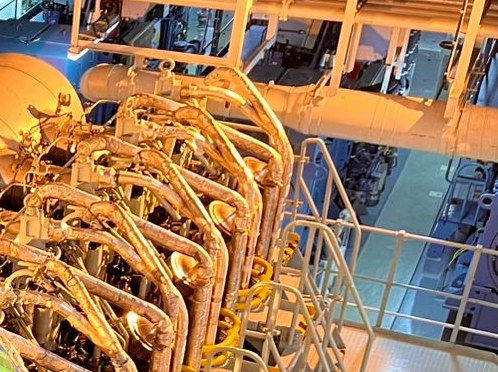
The main engine of a merchant ship seen from the walkway above, cylinder units and pipework lit amber
The main engine of a working ship. This is the marine engineer’s department. Photo: Capt. Robin C. George.

What to know before you list B.Tech Marine Engineering

A four-year engine degree

The course covers marine diesel engines, boilers, electrical systems, refrigeration, naval architecture, workshop practice and engine-room watchkeeping. Students live in and follow a set routine. The degree is awarded by the Indian Maritime University.

Entry through IMU CET

You take IMU CET, receive a rank and choose B.Tech Marine Engineering and a campus in IMU counselling. Some approved institutes also hold their own entrance test and interview. NavPath runs college-specific modules for those.

Verify course-specific eligibility and medical fitness

Check the current programme’s academic, English, age and medical conditions. An authorised examiner, not a coaching page or an assumption about glasses, determines fitness.

Where it is taught

IMU campuses and approved maritime institutes offer the course. The lists below name the ones Indian students commonly apply to. Approvals change year to year; check imu.edu.in and dgma.gov.in (DGMA, formerly DG Shipping) before paying a fee.

Company selection for engine cadets

Company selection and supervised ship training are separate from degree admission. The timing and assessments depend on the provider and programme. Read the actual written arrangement; a degree is not a company offer.

After the degree: the engine officer ladder

Graduates join a ship as an engine cadet or trainee marine engineer, complete the required sea time and sit the officer certificate exams. The ladder runs Fourth Engineer, Third Engineer, Second Engineer, Chief Engineer. The career ladder shows each step.

Deck or engine: how to decide

Choose engine study because its work and training suit your interests. Compare the actual programme, degree-awarding institution, course approval and supervised training arrangements.

Do not infer medical eligibility for one route from a difficulty with another. Ask the authorised examiner and the institution about the programme you are considering.

How NavPath prepares you for B.Tech Marine Engineering

  1. IMU CET coaching

    Physics, Chemistry, Maths, English and aptitude taught by subject faculty, timed mocks and an all-India practice rank.

  2. College-specific modules

    Exam and interview preparation built around the institutes that run their own B.Tech Marine Engineering selection.

  3. Technical interview practice

    Company-specific question banks, psychometric practice and mock panels run by our Marine Team.

  4. Parents in the loop

    Regular reports from week one, and a parent or guardian present at counselling.

Indian Maritime University campuses

Research directory, not confirmation that every listed institute offers this particular degree. Verify the exact current programme, approval and awarding body directly.

  • IMU Chennai
  • IMU Kochi
  • IMU Kolkata
  • IMU Mumbai Port
  • IMU Navi Mumbai
  • IMU Visakhapatnam

Maritime institutes offering B.Tech Marine Engineering and related courses

Research directory, not confirmation that every listed institute offers this particular degree. Verify the exact current programme, approval and awarding body directly.

  • Tolani Maritime Institute (TMI), Induri
  • Anglo-Eastern Maritime Academy, Karjat
  • Samundra Institute of Maritime Studies, Lonavala
  • The Great Eastern Institute of Maritime Studies, Lonavala
  • AMET, Chennai
  • HIMT College, Chennai
  • International Maritime Institute, Greater Noida
  • Applied Research International School of Maritime Studies, Delhi
  • Sriram Institute of Marine Studies, Delhi
  • Euro Tech Maritime Academy, Aluva
  • College of Ship Technology, Palakkad
  • Coimbatore Marine College, Coimbatore
  • Park Maritime Academy, Coimbatore
  • RL Institute of Nautical Sciences, Madurai
  • Southern Academy of Maritime Studies, Panapakkam
  • Maritime Training Institute (SCI), Powai
  • Maritime Training Institute (SCI), Thoothukudi
  • Training Ship Rahman, Mumbai
  • Vishwakarma Maritime Institute, Pune
  • Ganpat University (DNS), Gujarat

Questions families ask

Is JEE needed for B.Tech Marine Engineering?

For B.Tech Marine Engineering at IMU campuses and IMU-affiliated institutes, the entrance test is IMU CET, not JEE. Other engineering colleges may use other tests; check each college. Our IMU CET vs JEE guide compares the two exams.

Can I wear glasses and still do B.Tech Marine Engineering?

Check the current requirements for the actual programme and consult its authorised medical examiner. A coaching page cannot determine fitness, and a difficulty with one route does not establish eligibility for another.

Is the engine route open to girls?

Yes. Eligibility, the exam, the eye and colour-vision standards and company selection are the same for girls and boys; the minimum height differs (157 cm for boys, 145 cm for girls). Girls and boys train in the same batch at NavPath.

What does a marine engineer do on board?

Keeps the main engine, generators, boilers, pumps, fuel and fresh-water systems running; stands engine-room watches; plans and does maintenance; and keeps the logs. The engine officers report to the Chief Engineer.

Which closes at a higher rank, deck or engine?

Closing ranks differ by course, campus and year, and IMU publishes them after each counselling round. Neither route has a fixed marks floor. Our cutoff guide explains how to read the ranks.

Is B.Tech Marine Engineering the same as DNS?

No. IMU names them as separate programmes. DNS is the diploma route for the deck. B.Tech Marine Engineering is the engine degree.

Is GME a course I can join after Class 12?

No. GME is for engineering graduates, and AEMA lists it separately from DNS. After Class 12, the engine route is B.Tech Marine Engineering.

NavPath prepares Class 12 PCM students for IMU CET and for college and company selection. Rank and seat allotment are decided by IMU.

Separate degree admission from shipboard progression

Check who awards the degree, which exact course is approved and what the institute says about admission. Entrance qualification is not the same as admission, company selection or an employment offer.

Before comparing college costs or career outcomes, ask for the current official course documents and written ship-training conditions. NavPath can support IMU CET and interview preparation; those decisions remain with the appropriate bodies.

The engine programme IMU names

IMU’s public notice lists the DG Shipping programmes whose seats go through IMU CET: B.Tech Marine Engineering, B.Sc Nautical Science and DNS. The last two are deck courses. B.Tech Marine Engineering is the engine course on that list. A college that offers this seat “without IMU CET” is saying something the university’s notice contradicts.

IMU’s admissions FAQ adds two points. Without the required PCM average you are not eligible, even after qualifying in IMU CET. And admission to an IMU campus uses online counselling, not an interview.

What the engine degree trains you for

The IMO’s STCW Code sets the standards of training, certification and watchkeeping at sea. Chapter III covers the engine department, as Chapter II covers the deck. A marine engineering course trains you toward engine-room certificates. It is not the deck cadet route, and it is not naval architecture.

GME and ETO are different courses

AEMA’s admissions page lists DNS, GME (Graduate Marine Engineer) and ETO (Electro-Technical Officer) side by side. GME is for people who already hold an engineering degree. MTI also lists Graduate Marine Engineering apart from DNS.

So a Class 12 PCM student choosing now has two engine choices: B.Tech Marine Engineering, or a mechanical degree first and GME later. Those are different years of your life. ETO is an electrical course; do not file an ETO form if you want the engine-room degree. A mechanical B.Tech from a shore college is a shore degree. It does not, by itself, put you on a ship as an engineer officer.

Company tests on the engine side

Some ship managers run selection for engine cadets and GME, not only for deck. Synergy’s public entrance pages mention graduate marine engineering and engine cadet sponsorship beside its deck programmes. A company test is still not IMU CET. If your route needs both, you sit both.

Start with the eligibility check, then apply for NEST.

Call or WhatsApp +91 77365 22210.

WhatsApp us